Anyone who conducts deep digital research suffers from the same curse: hundreds of open tabs never read again, bloated web clippers that distort text formatting, and saved links that six months later return a 404 error or a private video. To break this cycle, I built my own personal research assistant: Kron, a dual system pairing a lightweight browser extension with a native macOS desktop app.
The Frustration of Traditional Web Clippers: Why Bookmarks Lie
For years I cycled through every tool on the market: Notion clippers, Evernote, Raindrop, Pocket, and browser bookmark folders. All fell prey to the same design flaws:
- Third-Party Cloud Dependency: When a platform changes its business model, restricts your account, or sunsets, years of research vanish.
- Link Rot: Saving only an external URL is wishful thinking. Instagram posts get archived, URLs change routes, and YouTube videos disappear.
- Capture Friction: If saving a single quote requires waiting for a heavy modal to load, picking a folder, adding mandatory tags, and waiting on sync, you simply stop saving.
My design goal for Kron was straightforward: one click to capture, zero cognitive overhead in the browser, and permanent storage in structured Markdown and local media files on the SSD.
Kron in Action: The Dual Architecture
A lightweight browser extension capturing quotes, images, SVGs, and audio, paired with a local macOS desktop app that structures, transcribes, and archives knowledge to SSD.
1. Direct Web Highlighting & Markdown Archiving
While reading technical essays, Kron lets you highlight paragraphs with double-click or Shift and save them along with the canonical URL.
In macOS, quotes enter as clean plaintext Markdown with date, provenance, and zero clipboard formatting junk.

Browser: Kron highlighting menu on the blog with selection hotkeys and one-click save.
macOS: Archivist view with structured Markdown notes, bidirectional links, and source provenance.
- Clean plaintext extraction without messy formatting
- Permanent link to original source
- Local SSD synchronization
1. Five Extraction Pipelines: From the Web to Local Disk
A product designer and systems engineer deals with diverse media every day. Kron's extension dynamically adapts to the context of the page you are browsing:
A) Clean Plaintext Highlighting & Quotes
When reading technical documentation or long-form essays, selecting text is instantaneous. Double-click selects a full paragraph; Shift extends selection.
- What it solves: Extracts pure plaintext without clipboard HTML formatting junk, appends the exact timestamp and canonical document URL, and lets you choose between saving a targeted excerpt or the entire article into your Markdown knowledge vault.
B) High-Resolution Image Scraping (Pinterest & Moodboards)
Pinterest is a goldmine for visual references, but its web frontend serves heavily compressed thumbnails designed for mobile devices.
- What it solves: Kron scans the board grid, locates raw original source files (e.g.
236x642or uncompressed studio dimensions), and enables batch preview and download with one click.
C) DOM SVG Vector Extraction & Inspection
How often have you tried to inspect an icon or logo on a site only to encounter complex inline SVGs riddled with conflicting classes and broken IDs?
- What it solves: Kron filters all SVG elements from the active DOM, displays them in a clean catalog with light/dark contrast toggles, sanitizes the XML, and offers one-click JSX/TSX copying ready for the design system.
D) YouTube Video Trimming & Local Whisper Transcription
Hour-long technical lectures (such as Andrej Karpathy’s deep dives on LLMs) contain immense value, but re-watching an entire video to find a specific phrase is impractical.
- What it solves: Kron injects an editing toolbar into the YouTube player:
[and]hotkeys mark in and out points on the fly.0selects the entire video.- Extracts audio as MP3 or runs local Whisper inference directly on Apple Silicon. Zero cloud API costs, blazing fast execution, and absolute privacy.
E) Instagram Profile & Full Carousel Archiving
Some of the sharpest UI teardowns and technical slides live in Instagram carousels. However, Instagram offers no native export and links rot quickly.
- What it solves: On author profiles (such as
@leonelkrea), Kron detects carousels and archives recent posts under a strict rule: download all carousel slides in sequence, preserving the full caption with hashtags and publish dates.
2. The Native macOS Desktop Archivist: Turning Chaos into Order
Capturing is only half the battle. If media dumps into a generic "Downloads" folder, knowledge is rendered useless. Kron's extension streams data in real time to a native macOS desktop application that organizes assets into four dedicated modules:
1. Color Moodboards (LK Images)
Stores visual assets and illustrations. Its key highlight is the automatic chromatic inspector: it analyzes incoming images, extracts dominant HEX color palettes (#F3F0E2, #84A7A3, #292723...), and offers one-click copying for Figma or CSS.
2. Second Brain with Segmented Transcriptions
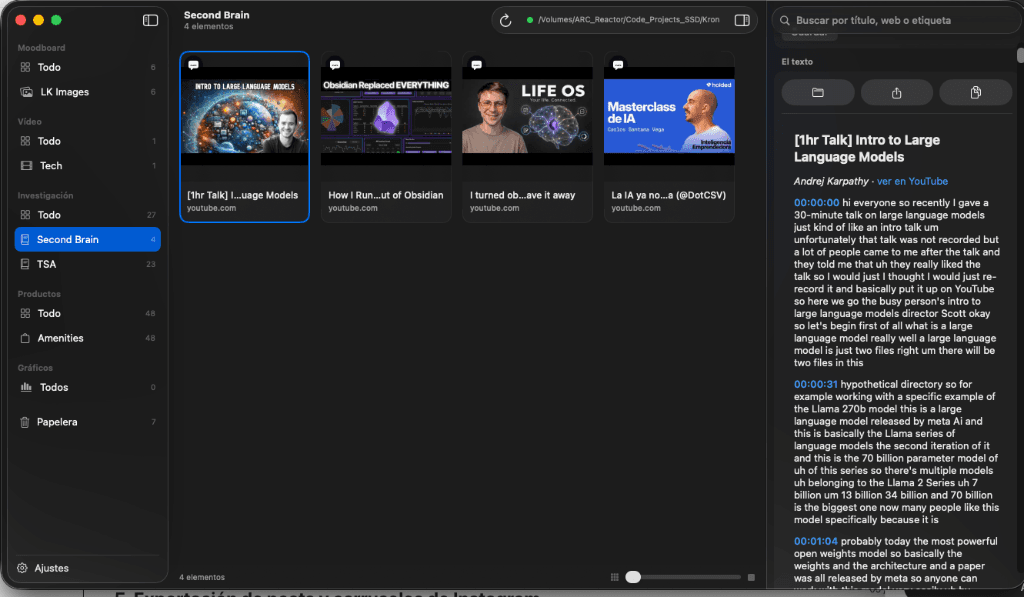
Every processed YouTube lecture enters this board with a complete record: channel, video length, canonical link, and the full transcript with clickable timestamps (00:00:00, 00:00:31, 00:01:04...). Search any keyword and jump directly to the second it was uttered.
3. Product Catalog & Commercial Specs (Amenities)
For physical product benchmarks or e-commerce tear-downs, Kron records EUR prices (154,00 €, 69,95 €...), source domains (Amazon, local suppliers), and packaging specs for instant comparisons.
4. Social Carousel Vault
A permanent archive where each Instagram post is stored as a self-contained bundle: numbered slide images plus a Markdown file with the unabridged copy. Even if the author deletes the post, the reference remains preserved on your local drive.
Conclusion: Build Tools That Respect Your Attention
We live surrounded by software designed to capture our attention through subscription paywalls, slow cloud interfaces, and proprietary formats that hold data hostage.
Building Kron reinforced a core principle of software craft: the best tool is the one that gets out of the way. A global shortcut, a contextual popup only when summoned, a friendly feline guardian, and your knowledge stored in open local formats you will still be able to open twenty years from now.