Tabletop RPG.
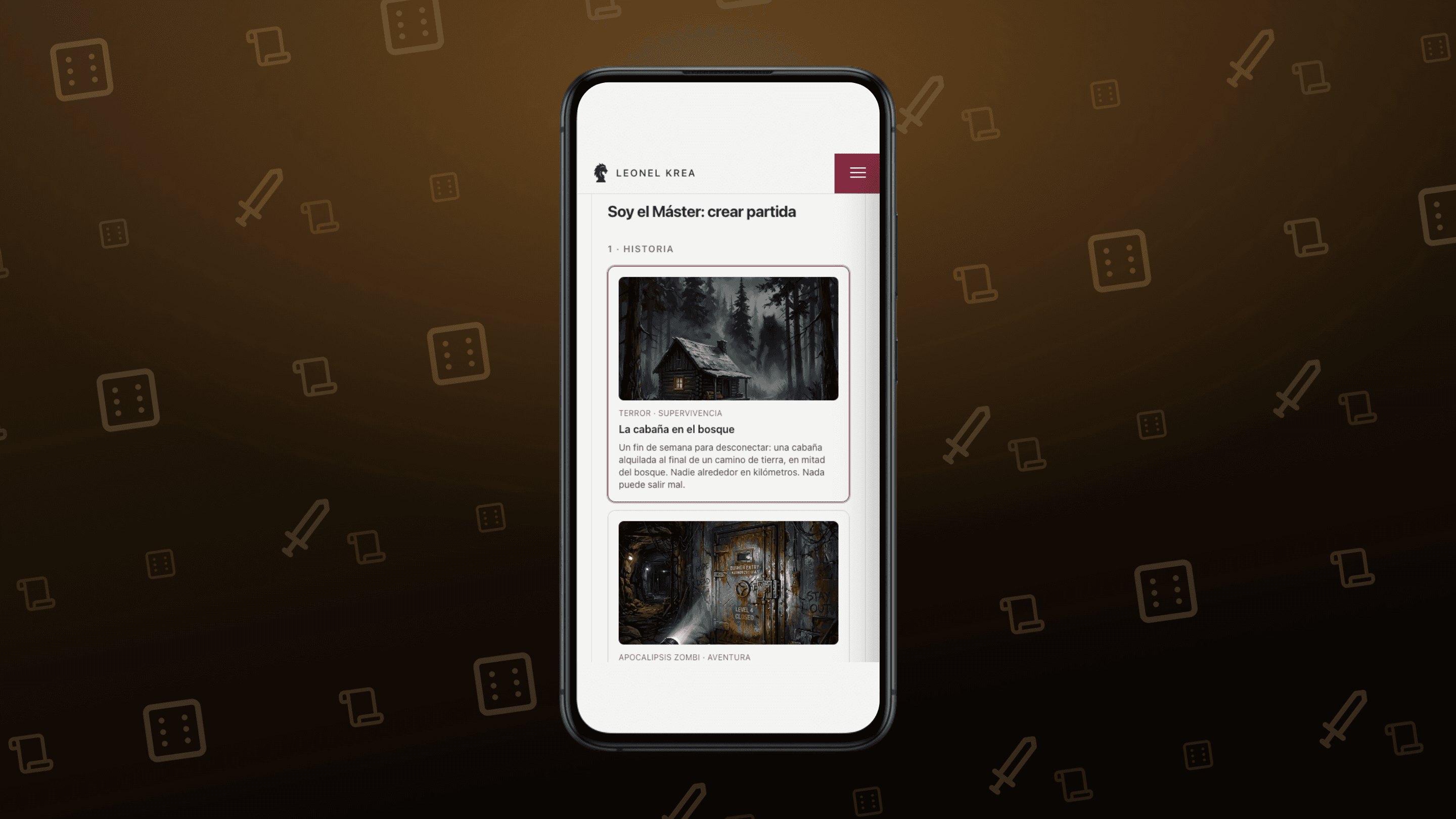
A roleplaying table you can play in one sitting, no manuals: the GM picks a story, hands each player a link or QR, and everyone plays from their phone, with live dice and character sheets.
01
Context
I wanted a roleplaying table that fit in an afternoon: simple, with human characters (no D&D), and that didn't force anyone to install anything or read a manual. Like The Wolf and The Impostor, a game you open from a link.
Real roleplaying happens through talking; the software's job is just to remove friction: hand out characters, roll dice and track health without having to write anything down.
02
Problem
A game with a GM and several players has an obvious temptation: build real-time sync, accounts and rooms. All of that is the perfect excuse to never finish it.
The challenge wasn't technical, it was scope: what's the minimum for it to feel like a shared table? What really needs to be synced and what can live on each phone?
03
Process
I separated the shared from the local. Dice are local, everyone rolls on their own phone, so they didn't need real-time sync. The only shared thing is health and the roster, and that's handled with a light poll to the database every few seconds.
The GM sets up the game from their phone (story, number of players, with or without health, characters assigned or up for choice) and hands out a link or QR per player. Each player opens their sheet full-screen, with the dice bar up top and their attributes below.
04
Decisions
The link is the identity: a secret token for the GM (they see the script and, in the mystery, who the killer is) and one per player (only their sheet). Security is guaranteed in the data, not the interface: the API returns different JSON depending on the role, so the GM's script never travels to a player's phone.
Characters with five attributes and a deliberately short bio, to leave room for interpretation; each story marks one attribute with an advantage. Choosing a character in free mode is an atomic operation: two players can't end up with the same one, first one wins.
I reused the rest of the lab: the same Mongo, token and QR patterns as the geocaching, and a dice bar in the design system used equally by the player and the GM.
05
Result
A table you can play from start to finish on your phone: the GM creates the game and hands out QRs, each player takes their character, rolls dice and sees their health; the GM sees everyone's state almost live and can adjust health, free up a slot or close the game.
Three stories to start (a cabin in the woods with something lurking, a shelter in a zombie apocalypse and a murder in a mansion with six suspects), with the structure ready to grow.
0
apps to install and manuals to read: it all runs from a link
06
Takeaways
Deciding what NOT to sync was the most important design decision: by keeping the dice local, a simple poll was enough and I saved myself all the real-time infrastructure.
Privacy between roles is a data question: if the GM's secret never leaves the server, there's no way to leak it from the client. And reusing the design system (the dice, the maps, the data patterns) makes each new game cost less than the last.
From the Lab
It's here to play.
It's not a demo or a video: it's the project running on this very site. Open it and play.
Have a similar
project?
Now that you've seen a bit of how I work, tell me about yours: let's treat brand, product and code as one system.
Let's talk about your project